

Prime rib for a crowd: how to buy and roast a standing rib roast
One rib feeds about two people. How to order a standing rib roast, dry-brine it, roast it low and slow, sear it, carve it and make a quick jus.
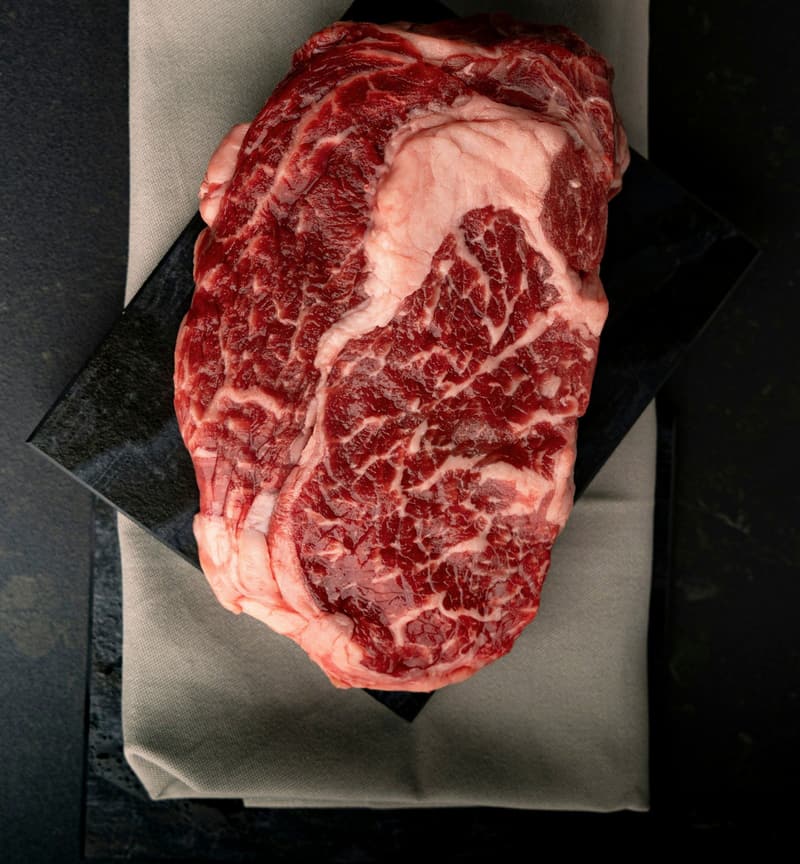
The short answer
Plan on one rib for every two people, so a 4-rib roast feeds about 8. Salt it a day ahead, roast it at 250°F (120°C) until the centre reads about 60°C (140°F), rest it, then blast it in a 500°F (260°C) oven for a crust. It climbs to Health Canada’s medium-rare, 63°C (145°F), through the rest and the sear.
A standing rib roast is the whole rib section of beef, roasted standing on its own bones. Slice it between the bones and you’d have ribeye steaks. Roast it whole and you have the thing everyone photographs before they eat. “Prime rib” is the traditional name of the roast, not a grade of beef.
How much to order
One rib feeds about two people.
- 4 people: 2 ribs
- 6 people: 3 ribs
- 8 people: 4 ribs
- 10 to 12 people: 5 to 6 ribs
- 14 people: 7 ribs, the whole rib section
Want leftovers for sandwiches? Add a rib.
Ordering from us
Call 519-846-8600 or send a pre-order request well ahead of your dinner, especially around the holidays. Tell us how many people and the day you’re cooking, plus anything you’d like done:
- Bone-in or boneless. Bones add flavour and act as a built-in roasting rack.
- Bones off and tied back on. You keep the flavour of bone-in, and carving is easy.
- Which end. The small end, nearest the loin, is leaner with a bigger eye. The large end, toward the shoulder, has more fat and more of the cap.
We cut in-house and we’re always happy to customize an order, so ask.
The day before: dry brine
Salt the roast all over, about 1 teaspoon of coarse kosher salt per pound, or half that of table salt. Set it on a rack over a tray in the fridge, uncovered, for a day, or up to two. The salt seasons the meat deeply and dries the surface for a better crust. Pepper goes on just before roasting.
Low and slow, then sear
This is the reverse sear. You get rosy meat from edge to edge and a crust at the end, and it’s hard to mess up.
- Heat the oven to 250°F (120°C).
- Set the roast bone side down in a roasting pan. The bones are your rack; use a wire rack if it’s boneless. Put a probe thermometer into the centre of the thickest part, not touching bone.
- Roast until the centre reads about 60°C (140°F). Plan on roughly 3 to 5 hours: closer to 3 for a two- or three-rib roast, closer to 5 for a big one. Start checking after 2 hours.
- Take it out, tent it loosely with foil and rest it at least 30 minutes, and up to 90. That’s your buffer if the potatoes run late.
- Turn the oven up as high as it goes, 500°F (260°C) or more.
- Ten minutes before dinner, put the roast back in for 6 to 10 minutes, until the outside is deep brown and sizzling. Check the centre once more, then carve right away.
Temperatures
Health Canada’s guidance for beef roasts is 63°C (145°F) for medium-rare, 71°C (160°F) for medium and 77°C (170°F) for well done. Take the roast out of the low oven about 3°C (5°F) under your target. It climbs through the rest and the sear. If your crowd likes it pinker than 63°C, know that’s below the guideline, and make the call for your table.
Carving
If the bones were tied on, snip the string and lift the roast off them. If not, stand it up and run a sharp knife along the curve of the bones to take the meat off in one piece. Lay it flat and slice against the grain, ½ to ¾ inch (1 to 2 cm) thick. Cut the bones apart and serve them on the side. Someone will claim them before you’ve put the knife down.
A quick jus
While the roast rests, spoon a tablespoon of fat from the roasting pan into a saucepan over medium heat. Cook a finely chopped shallot in it for 2 minutes. Add ½ cup (125 mL) of red wine and let it bubble for a minute. Add 2 cups (500 mL) of beef stock, a sprig of thyme and any drippings from the pan, and simmer until it’s reduced by about a third, around 10 minutes. Strain it, season it and pour in the juices from the carving board. Horseradish on the side, always.
Leftovers
Get leftovers into the fridge within two hours and eat them within 2 to 3 days. Reheating to Health Canada’s 74°C (165°F) will cook the pink out, which is a good argument for eating it cold, sliced thin on a bun with horseradish.
Questions
How many people does a rib roast feed?
About two people per rib. A 3-rib roast feeds 6 and a 4-rib roast feeds 8. Add a rib if you want leftovers.
What temperature should prime rib be cooked to?
Health Canada’s guidance for beef roasts is 63°C (145°F) for medium-rare, 71°C (160°F) for medium and 77°C (170°F) for well done. With the low-and-slow method, take it out about 3°C (5°F) below your target.
Is prime rib the same as Prime grade beef?
No. Prime rib is the traditional name for a standing rib roast. It doesn’t tell you the grade of the beef.
Bone-in or boneless?
Bone-in for flavour and a built-in roasting rack, boneless for easy carving. Or ask us to cut the bones off and tie them back on, and you get both.
Food-safety temperatures: source 1, source 2 (Health Canada).